The question we get asked most is some version of "should I get a 10 or a 12?". It is the wrong question, or at least the second question. The enclosure the driver sits in has more effect on how the bass sounds than the diameter printed on the dust cap, and the boot you have to give up is decided by the box, not the cone.
Why a subwoofer at all?
A door speaker is mounted in a leaky, oddly shaped enclosure that also contains a window. Below roughly 60 Hz it simply cannot move enough air, and what it does produce cancels itself as pressure escapes around the frame. That is why bass-heavy tracks sound thin in a standard car and why turning up the bass control makes the mid-range distort rather than the bass appear.
A subwoofer takes everything below about 80 Hz off the door speakers. Two things happen at once: you get low bass that was never there, and the front speakers stop trying to produce it, so the mid-range cleans up noticeably. The second effect surprises people more than the first.
What the diameter really buys you
Cone area rises with the square of the radius, so the steps are larger than they look:
| Nominal size | Effective cone area | Relative to an 8 inch | Typical useful low end |
|---|---|---|---|
| 8 inch (200 mm) | ~210 cm² | 1.0× | 40 Hz |
| 10 inch (250 mm) | ~330 cm² | 1.6× | 32 Hz |
| 12 inch (300 mm) | ~490 cm² | 2.3× | 28 Hz |
Two things follow from that table. First, a 12-inch does not play twice as low as an 8-inch; it plays a little lower and considerably louder at the bottom. Second, a bigger cone moving a short distance shifts the same air as a smaller cone thrashing, which is why larger drivers usually sound more relaxed at the same volume.
The trade is control and space. A heavy 12-inch cone has more inertia, so it can sound slower through fast bass lines unless the enclosure and the amplifier are up to it. It also needs a much bigger box.
Sealed, ported and bandpass
Sealed boxes are airtight. The trapped air acts as a spring, so the roll-off below the driver's resonance is gentle — about 12 dB per octave — and the bass sounds tight and accurate. They are smaller, more forgiving of a slightly wrong volume, and they are what we fit to most cars.
Ported (or vented) boxes add a tube tuned to a specific frequency. Around that tuning point the port does much of the work, which is worth 3–6 dB of extra output for the same power — the reason ported builds deliver that big bass wallop. Below tuning, cone control disappears sharply, so a subsonic filter is essential. Ported boxes are roughly twice the size of the sealed equivalent and much less forgiving of a sloppy build.
Bandpass boxes put the driver inside a sealed chamber firing into a ported one. Very loud over a narrow range, poor outside it, and awkward to get right. We build them occasionally on request but rarely recommend them.
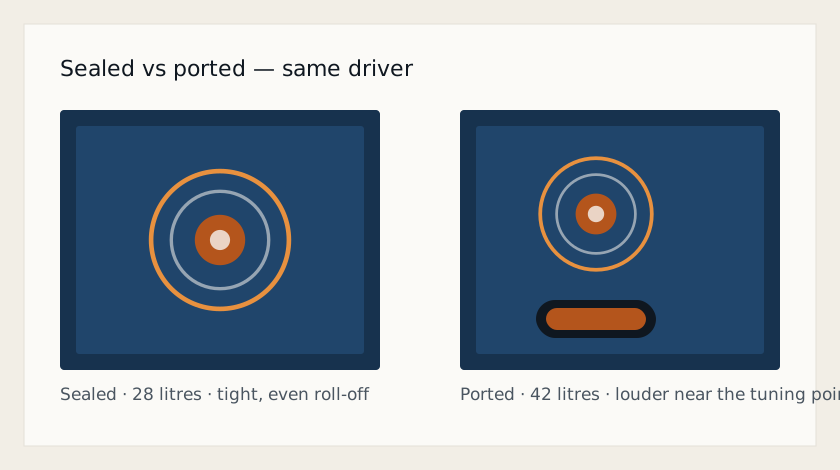
The volumes we build to
Manufacturers publish a recommended range for each driver, and it is worth following. As a starting point, these are the internal volumes we work to for a typical UK install, excluding the space the driver and bracing occupy:
| Driver | Sealed | Ported | Typical port tuning |
|---|---|---|---|
| 8 inch | 10–14 litres | 20–25 litres | 38 Hz |
| 10 inch | 18–28 litres | 34–45 litres | 34–36 Hz |
| 12 inch | 30–45 litres | 55–70 litres | 32–34 Hz |
Smaller box, tighter bass — up to a point
Building under the recommended sealed volume raises the system's resonant frequency: you lose depth but gain control. Going well under it makes the driver work against a stiff air spring, which costs output and can push the voice coil past its comfortable travel. We will build up to about 20 per cent under a manufacturer's figure and no further.
Fitting it into a real boot
This is where most plans meet reality. Some options that keep a usable boot:
- Spare wheel well. On many estates and hatchbacks the well swallows a shallow 10-inch sealed box entirely, leaving the floor flat. Our most popular build.
- Shallow-mount drivers. Around 90 mm deep instead of 150 mm, designed for exactly this. Slightly less excursion, but in a sealed box the difference is small.
- Under-seat enclosures. Usually 6 to 8 inch actives producing useful bass down to about 45 Hz. No boot loss at all, and a good answer for a company car.
- Side-panel builds. A shaped box in the recess beside the boot, trimmed to match. More fabrication, but you keep the floor and most of the width.
Measure before you commit. A 58-litre ported box for a 12-inch is roughly 700 × 400 × 350 mm externally once the timber is accounted for, which is a third of a typical hatchback boot.
Matching power to the driver
Match the amplifier's RMS output at the wired impedance to the driver's RMS rating. A 300 W RMS subwoofer wants a mono amplifier producing something between 250 W and 400 W at the impedance it is actually wired to — and that last part catches people out. A dual 4 Ω voice coil wired in parallel presents 2 Ω, and most amplifiers make roughly half again as much power into 2 Ω as into 4 Ω.
Sealed boxes need more power than ported ones for the same loudness, because they lack the port's efficiency gain. Budget accordingly: a sealed 12-inch is a hungrier proposition than the ported version of the same driver.
Picking one: three worked examples
Focus hatchback, mostly commuting, boot needed for shopping. Shallow 10-inch, sealed, 24 litres, in the spare wheel well, 300 W RMS mono. Deep, tidy bass, flat boot floor.
Octavia estate, dog in the back, likes dub and drum and bass. 12-inch sealed at 40 litres against the offside panel, 500 W RMS. Sealed keeps fast bass lines distinct where a ported build would smear them, and the dog keeps the floor.
Corsa, second car, wants it as loud as sensibly possible. 12-inch ported at 58 litres tuned to 34 Hz, 600 W RMS, subsonic filter at 28 Hz. The big bass option — accepting that the boot is now mostly subwoofer.
Whichever route you take, the enclosure has to be built for the specific driver and the bass level blended to the front speakers afterwards. Our bass tuning notes cover that second half of the job.