The best compliment a subwoofer can get is that you cannot tell where it is. Bass should appear to come from the front of the car, arrive at the same moment as the rest of the music, and disappear the instant the track has no low content. Big bass and clean bass are not opposites — but getting both means four settings have to be right, and each affects the others.
What good bass sounds like
Three tests we run on every car before handover:
- Localisation. With the music playing, can you point at the subwoofer with your eyes shut? If yes, the crossover is too high or the level is too far up.
- Definition. On a track with a walking bass line, can you hear the individual notes change pitch, or does every note arrive at the same loudness? The second is one-note boom.
- Stopping. When the bass note ends, does it stop, or does it hang for a fraction of a second? Hanging usually means an over-large enclosure or a badly damped boot.
Crossover point and slope
The crossover decides which speaker plays what. Two settings work together: the subwoofer's low-pass filter, and the front speakers' high-pass filter.
| Front speakers | Sub low-pass | Front high-pass | Notes |
|---|---|---|---|
| Untreated doors, 165 mm | 85 Hz | 85 Hz | Take the strain off early |
| Damped doors, 165 mm | 70–80 Hz | 70–80 Hz | Our usual setting |
| Damped doors with an amplifier | 63–70 Hz | 63–70 Hz | Best integration |
| Small 130 mm front speakers | 100 Hz | 100 Hz | Watch for localisation |
Set both filters to the same frequency as a starting point. A 12 dB per octave slope is the normal choice; 24 dB per octave keeps the subwoofer more hidden but can leave a dip at the crossover point if the two are not level-matched.
Above about 90 Hz the human ear starts to locate low sound, so a subwoofer crossed at 120 Hz will always announce itself from behind you. If your front speakers cannot cope below 90 Hz, the answer is damping the doors, not raising the crossover.
Subsonic filters
A ported enclosure loses control of the cone below its tuning frequency — the air in the port stops loading the driver and excursion rises sharply for no useful output. A subsonic (high-pass) filter set roughly 5 Hz below the port tuning protects it. For a box tuned to 34 Hz, set the subsonic filter at about 28–30 Hz.
Sealed boxes do not need one, because the trapped air keeps controlling the cone all the way down. If you have a sealed enclosure and the amplifier has a subsonic filter, leave it off or set it as low as it will go.
Phase and polarity
Around the crossover point both the subwoofer and the front speakers are producing the same frequencies. If they are out of step, they partly cancel and you get a hole in the response exactly where the bass should hand over. This is the single most common reason a system sounds thin despite a big subwoofer.
Checking it takes two minutes:
- Play a track with steady, continuous bass around the crossover frequency.
- Listen from the driver seat at moderate volume.
- Flip the phase switch on the amplifier (or swap the subwoofer's speaker wires).
- Keep whichever setting gives more bass. It is not subtle when it is wrong.
If the amplifier has a continuously variable phase control rather than a 0/180 switch, sweep it slowly and stop at the loudest point. Distance from the listener changes the correct setting, which is why a boot subwoofer and a front stage often need something other than 0 degrees.
Setting the level
Set the subwoofer level with the bass control on the head unit at zero, not turned up. The head unit's bass control boosts a wide band and will drive the front speakers into distortion long before it helps the subwoofer.
Our method: turn the subwoofer gain down until you cannot hear it at all, then raise it slowly on a familiar track until the bass sounds full but you can no longer point at the boot. Then leave it there for a week of normal driving before deciding whether it needs more. Almost everyone sets it too high on the first day and finds it fatiguing by the third.
Cabin gain and one-note boom
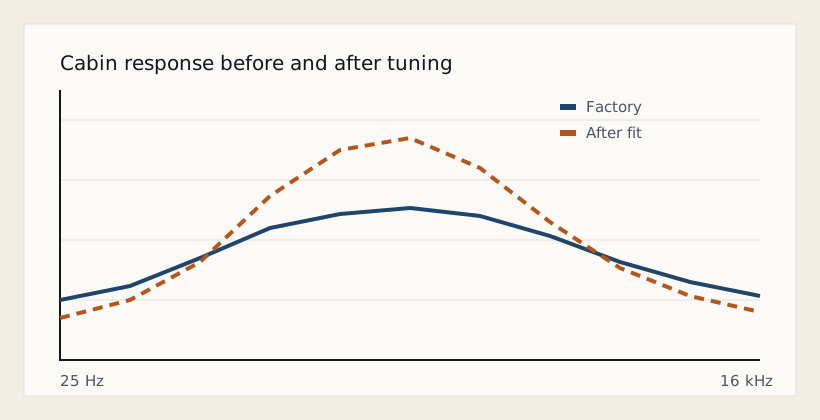
A car interior is a small sealed space, so below roughly 80 Hz it reinforces bass by around 12 dB per octave as frequency falls. That free gain is why modest subwoofers work well in cars. It also means the response is rarely flat: most cabins have a strong peak somewhere between 45 Hz and 70 Hz, set by the dimensions of the car and the position of the box.
That peak is one-note boom. Every bass note excites it, so every note sounds like the same note. Three fixes, in the order we try them:
- Move the enclosure. Facing the box rearwards instead of forwards, or moving it 200 mm across the boot, often shifts the peak by several decibels for no money at all.
- Damp the boot. The peak is usually made worse by a resonating boot floor or parcel shelf, which rings at a single frequency.
- Cut it with EQ. A narrow cut of 3–6 dB at the measured peak. Always cut rather than boost elsewhere; boosting costs headroom and excursion.
Chasing rattles
A rattle is not a tuning problem, but it will ruin good bass, and there is no point setting a level around a noise you could eliminate. Play a slow sine sweep from 30 Hz to 100 Hz at moderate volume and walk around the car with the boot open, then closed. The usual culprits, in order of how often we find them: number plate and its surround, parcel shelf ends, boot lid trim clips, rear light cluster mounts, spare wheel tools and the jack.
Most are fixed with a strip of closed-cell foam, a new clip or by tightening something. It takes half an hour and makes more difference to perceived bass quality than any amplifier setting.
The road test
Everything above is set with the car stationary. Road noise fills in the bottom two octaves once you are moving, so a system tuned only on the drive will sound bass-light at 70 mph and overblown when parked.
We do the final check on a fixed route: a stretch of dual carriageway, a rough B-road and a slow run through town, with the customer in the car and their own music playing. Small level and crossover adjustments happen there, and anything that turns up in the first fortnight is covered by a free return visit.
If your system has never been tuned this way, it is worth an hour on the ramp even if we did not fit it. Bring it in and we will measure it, tell you what is going on, and set it properly.