Amplifier specifications are where car audio marketing is at its most creative. A box can legitimately claim 1,600 watts and produce 260 watts of usable output. None of that is hidden — it is all in the small print — but you have to know which line to read.
Reading the ratings honestly
Look for RMS power at a stated impedance and distortion figure. A trustworthy specification reads something like "85 W RMS × 4 at 4 Ω, 14.4 V, 1% THD". Every part of that matters:
- RMS is continuous output the amplifier can actually sustain.
- At 4 Ω tells you the load. The same amplifier makes more into 2 Ω.
- 14.4 V is the supply voltage with the engine running. Quotes at 12 V are more honest for a parked car and will read lower.
- 1% THD is the distortion at which the figure was taken. A rating quoted at 10% THD is measuring an amplifier already audibly straining.
"Max", "peak" and "dynamic" power figures describe milliseconds and can be safely ignored when matching. If an amplifier only publishes a peak figure, assume the RMS output is somewhere around a quarter of it and treat the omission as a warning.
Impedance changes everything
Impedance is the load in ohms that the speakers present. Lower impedance draws more current, so the amplifier produces more power — and runs hotter.
| Wiring | Load seen by the amplifier | Typical output change |
|---|---|---|
| One 4 Ω speaker per channel | 4 Ω | Baseline |
| Two 4 Ω speakers in parallel | 2 Ω | About 1.5× baseline |
| Dual 4 Ω voice coils in series | 8 Ω | About 0.6× baseline |
| Dual 2 Ω voice coils in parallel | 1 Ω | Mono amplifiers only |
Never present an amplifier with a lower impedance than it is rated for. A two-channel amplifier rated to 2 Ω stereo will overheat and shut down into 1 Ω, and if its protection is poor it will fail instead. Check the subwoofer's voice coil configuration before you buy the amplifier, not after.
Bridging and channel counts
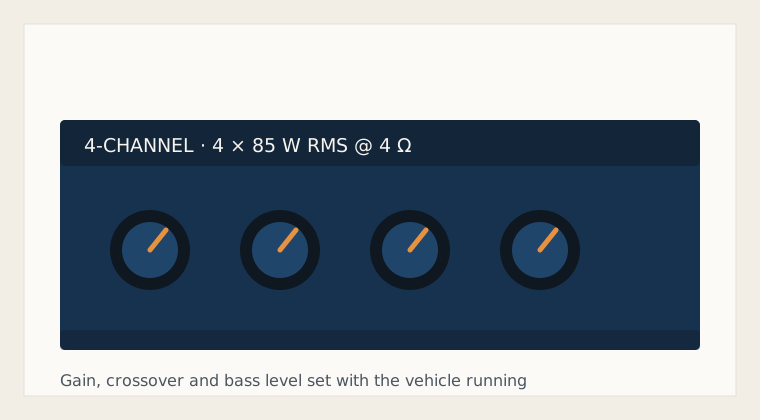
Bridging combines two channels into one with roughly three times the power of a single channel, but it halves the impedance the amplifier internally sees. A four-channel amplifier rated 85 W × 4 at 4 Ω typically gives about 240 W × 2 bridged at 4 Ω — and usually cannot be bridged into 2 Ω at all.
A practical layout for most cars: four channels, with two running the front speakers and two bridged into a subwoofer. Add a five-channel or a separate mono amplifier only when the subwoofer needs more than about 300 W.
How much headroom to allow
Aim for amplifier RMS output between 75 per cent and 150 per cent of the speaker's RMS rating. Inside that window the amplifier can drive the speaker to its limit without being pushed to its own, which is the safe combination.
Deliberately over-powering is a legitimate technique: an amplifier producing 150 W into a 100 W speaker spends its life loafing, and a clean 150 W is far kinder to a voice coil than a clipped 100 W. It relies on the gain being set correctly and the listener not simply turning everything to maximum.
Setting the gain properly
The gain matches the amplifier's input stage to the output voltage of your head unit. Set too high, the amplifier clips before the volume knob reaches the top; set too low, you never get the power you paid for. This is the method we use, and it needs an oscilloscope or a decent distortion-detection tool:
- Disconnect the speakers. Set every crossover, bass boost and EQ to flat or off.
- Play a 1 kHz sine test tone recorded at 0 dB (or 50 Hz for a subwoofer channel).
- Turn the head unit up to about 75 per cent of its maximum — the point most units still output a clean signal.
- With the scope on the amplifier's speaker terminals, raise the gain slowly until the sine wave starts to flatten at the peaks, then back it off until the wave is clean again.
- Reconnect the speakers, set the crossovers for the drivers, and re-check on music.
If you are doing this by ear
Play a familiar track, raise the head unit to three-quarters, then bring the gain up until you first hear distortion or harshness — and back off a clear quarter-turn from there. It is not as accurate as a scope, but it is far better than setting the gain to maximum, which is what we find on most cars that arrive with a burnt voice coil.
Cable and fuse sizing
An amplifier can only produce what the cable delivers. Undersized power cable causes voltage drop, which shows up as bass that goes soft when the system is working hardest.
| Total system RMS | Power cable | Fuse at the battery |
|---|---|---|
| Up to 300 W | 8 AWG (8.4 mm²) | 40 A |
| 300–600 W | 4 AWG (21 mm²) | 60–80 A |
| 600–1,200 W | 1/0 AWG (53 mm²) | 150 A |
Three rules we never bend: the main fuse goes within 300 mm of the battery positive terminal; the earth is as short as practical and taken to sanded bare metal on the chassis; and the power cable never shares a grommet or a channel with the RCA signal cables, because it will put alternator whine into the system.
What goes wrong
- Amplifier goes into protection when the bass hits. Usually a load below its rating, or a poor earth. Check the impedance the subwoofer is actually wired to first.
- Whining that rises with engine speed. Signal cable routed alongside power, or an earth loop between the head unit and the amplifier.
- Bass goes soft at volume. Voltage drop. Measure at the amplifier terminals while it is working — below 12 V and the cable or the battery is the problem, not the amplifier.
- One speaker sounds quiet and rough. Almost always a partially failed voice coil from earlier clipping. Amplifiers rarely kill speakers; clipped amplifiers do it regularly.
If any of that is happening in your car, bring it in. Diagnosis on the ramp takes about an hour and we will tell you what is wrong even if the fix is not something we sell.