Every week someone arrives with a boxed set of car speakers that will not go into their door. Usually the diameter is right and the mounting depth is not, or the tweeter fouls the window mechanism, or the set needs an external crossover that has nowhere to live. None of that is the buyer's fault: the specification that matters is rarely the one printed largest.
This is the order we check things in the bay, and it is a sensible order to shop in too.
1. Will it physically fit?
Three measurements decide this, and all three are easy to take once the door card is off.
- Nominal diameter. Most UK and European cars use 165 mm (often written 6.5 inch) in the front doors. Many Japanese and Korean models use 160 mm, and rear parcel shelves are frequently 6 × 9 inch ovals. Some superminis use 130 mm.
- Mounting depth. Measure from the face of the mounting flange to the nearest obstruction behind it — normally the window glass at its lowest point, or the regulator rail. If you have 58 mm of clear space, a 62 mm speaker will foul the glass, and you will only find out when the window is wound down.
- Cut-out diameter and bolt pattern. These almost never match between manufacturers, which is why an adaptor ring exists. A proper ring also spaces the driver away from the metal and gives you a flat, sealed mounting surface.
Rule of thumb
If the speaker's stated depth is within 6 mm of your measured clearance, assume it will not fit without a spacer. Glass flexes, and door skins are not as flat as they look.
2. Coaxial or component?
A coaxial speaker carries the tweeter on the same frame as the mid-bass cone. It drops into the factory hole, needs no extra wiring and is the right answer for most cars running a standard head unit. The compromise is that the tweeter fires wherever the door aims it, which in most cars is at your left knee.
A component set separates the tweeter so it can be mounted in the A-pillar, the sail panel or the top of the door card, angled towards the listener. That single change is what lifts the sound stage off the floor and puts vocals on the dashboard. It also needs a crossover box mounting somewhere dry, and roughly twice the fitting time.
If the budget is tight, a good coaxial set fitted properly beats a component set fitted badly by a wide margin. If you are chasing a proper stereo image, components are the only route.
3. Sensitivity
Sensitivity is quoted in decibels at 1 watt measured 1 metre away, and it tells you how loud a speaker plays for a given amount of power. It is the single most useful number on the box if you are keeping your factory head unit.
The scale is unforgiving: every 3 dB of extra sensitivity is worth doubling your amplifier power. A 91 dB speaker on a 20 W factory head unit plays as loudly as an 88 dB speaker fed 40 W, and as loudly as an 85 dB speaker fed 80 W.
| Sensitivity | Suits | Power needed for a lively result |
|---|---|---|
| 92–94 dB | Factory head unit, no amplifier | 15–25 W RMS |
| 89–91 dB | Factory head unit or a small amplifier | 25–50 W RMS |
| 86–88 dB | Amplified systems only | 60–100 W RMS |
Low-sensitivity speakers are not worse. They are often the more capable driver, built with a heavier cone and a stiffer suspension, and they reward the amplifier they were designed for. They just sound flat and disappointing on a head unit that cannot feed them.
4. Power handling and impedance
Ignore the peak or "max" figure entirely. It describes a brief burst the speaker survives, not anything it can do continuously, and manufacturers are creative with it. The number to read is RMS (sometimes called continuous or nominal power), and it should be quoted at a stated impedance.
Impedance is the electrical load the speaker presents, in ohms. Car speakers are nearly always 4 Ω. Some subwoofers are 2 Ω or dual 4 Ω, which lets an installer wire them for a particular amplifier. Fitting a 2 Ω speaker where the amplifier expects 4 Ω makes it run hot and can push it into protection.
Aim to match the amplifier's RMS output to the speaker's RMS handling within about 25 per cent either way. Slightly more amplifier than the speaker is rated for is safer than slightly less, because an amplifier driven into clipping sends the speaker a distorted, high-energy signal that cooks voice coils. Our amplifier power matching guide works through the arithmetic and the gain-setting method.
Cone and surround materials
Materials matter less than the marketing suggests, but there are real differences worth knowing about in a car, which is a hot, damp and vibrating environment.
- Polypropylene cones are the sensible default. Damp, stable, unbothered by humidity and cheap enough to be well made at a normal price.
- Woven glass fibre and paper composites are lighter and often more detailed, at the cost of some resilience to moisture. Fine in a door with a properly sealed vapour barrier.
- Metal cones are stiff and can sound very clean, but they have a sharp breakup mode that needs a good crossover to keep out of the way.
- Rubber surrounds outlast foam by years in a car door. Foam perishes from the inside out and is the usual reason a fifteen-year-old factory speaker buzzes.
Silk-dome tweeters generally sound softer, metal domes brighter. Neither is correct — it is genuinely a matter of taste, and worth listening to before you buy if you can.
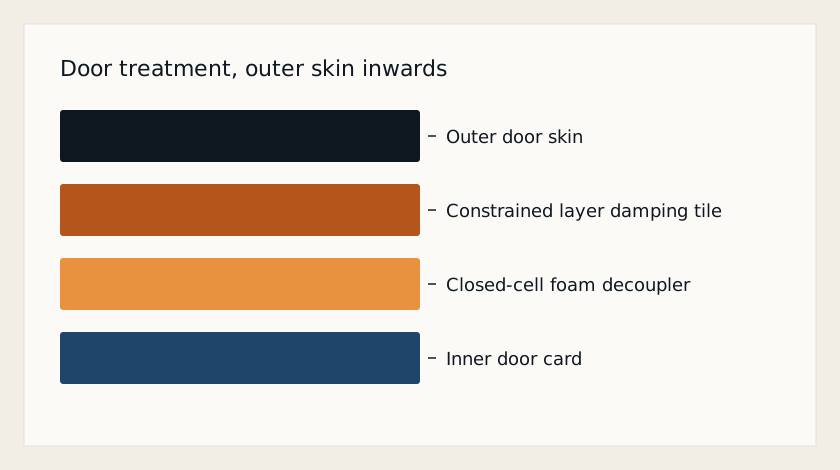
The order we would spend money in
Given a fixed budget, this is where each pound does the most work in a typical car:
- Damp and seal the front doors. Roughly £250–£300 fitted, and it improves whatever speakers you already own. Mid-bass gains of 3–5 dB are normal.
- Replace the front pair. The front stage is where nearly all the music sits.
- Add an amplifier. Real power lets a decent speaker relax and control its own cone.
- Add a subwoofer. Doors cannot produce genuine low bass; a subwoofer is the only way to get it without ruining the mid-range.
- Replace the rears. Last, and often not at all. In most cars they only fill in for passengers and can blur the stage if run too loud.
Five mistakes we see weekly
- Buying on peak wattage. A 400 W-peak speaker fed 18 W from a factory radio sounds exactly like an 18 W speaker, only heavier.
- Skipping the adaptor ring. Bolting a driver to a curved door skin leaves gaps, and every gap short-circuits bass from the front of the cone to the back.
- Removing the vapour barrier and not replacing it. That plastic sheet keeps water off your door card and out of the speaker. Cut a hole in it and it stops doing both jobs.
- Running new speakers on old, undersized factory wiring. Acceptable for a coaxial set on head-unit power, a real limitation once an amplifier is involved.
- Turning the head unit bass control fully up. That is the fastest way to make a new set of car speakers distort, and it hides whatever you just paid for.
If you would rather not measure your own door, send us the registration through the enquiry form and we will tell you the sizes, depths and adaptors your car needs, whether or not you have the work done here.